

Surds and Exact Trig Values H
The Skill
A surd is an irrational root that cannot be simplified to a rational number. Examples include $\sqrt{2}$, $\sqrt{3}$, $\sqrt{5}$.
Surds give exact answers — more precise than decimals.
Simplifying Surds
To simplify a surd, find a square factor:
$$\sqrt{12} = \sqrt{4 \times 3} = \sqrt{4} \times \sqrt{3} = 2\sqrt{3}$$
$$\sqrt{45} = \sqrt{9 \times 5} = \sqrt{9} \times \sqrt{5} = 3\sqrt{5}$$
Method: Find the largest square number that divides into the number under the root.
Surd Rules
$$\sqrt{a} \times \sqrt{b} = \sqrt{ab}$$
$$\frac{\sqrt{a}}{\sqrt{b}} = \sqrt{\frac{a}{b}}$$
$$(\sqrt{a})^2 = a$$
$$\sqrt{a} + \sqrt{a} = 2\sqrt{a}$$ (like terms)
Warning: $\sqrt{a+b} \neq \sqrt{a} + \sqrt{b}$
Rationalising the Denominator
We don't leave surds in denominators. To rationalise:
Simple case: Multiply top and bottom by the surd. $$\frac{1}{\sqrt{3}} = \frac{1}{\sqrt{3}} \times \frac{\sqrt{3}}{\sqrt{3}} = \frac{\sqrt{3}}{3}$$
With two terms: Multiply by the conjugate (change the sign). $$\frac{1}{3+\sqrt{2}} = \frac{1}{3+\sqrt{2}} \times \frac{3-\sqrt{2}}{3-\sqrt{2}} = \frac{3-\sqrt{2}}{9-2} = \frac{3-\sqrt{2}}{7}$$
Exact Trigonometric Values
These must be memorised for the exam (no calculator allowed for these):
| Angle | $\sin$ | $\cos$ | $\tan$ |
|---|---|---|---|
| 0° | 0 | 1 | 0 |
| 30° | $\frac{1}{2}$ | $\frac{\sqrt{3}}{2}$ | $\frac{1}{\sqrt{3}}$ or $\frac{\sqrt{3}}{3}$ |
| 45° | $\frac{\sqrt{2}}{2}$ or $\frac{1}{\sqrt{2}}$ | $\frac{\sqrt{2}}{2}$ or $\frac{1}{\sqrt{2}}$ | 1 |
| 60° | $\frac{\sqrt{3}}{2}$ | $\frac{1}{2}$ | $\sqrt{3}$ |
| 90° | 1 | 0 | undefined |
Memory Tricks
For sine: The pattern for 0°, 30°, 45°, 60°, 90° is: $\frac{\sqrt{0}}{2}, \frac{\sqrt{1}}{2}, \frac{\sqrt{2}}{2}, \frac{\sqrt{3}}{2}, \frac{\sqrt{4}}{2}$
For cosine: Same values but in reverse order.
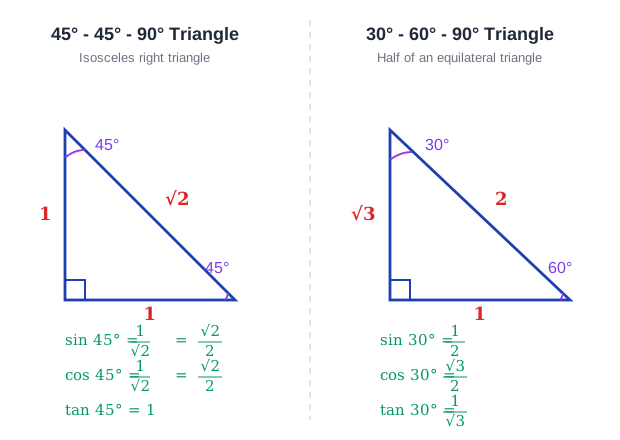
The two special triangles:
- 45-45-90 triangle: Sides in ratio $1:1:\sqrt{2}$
- 30-60-90 triangle: Sides in ratio $1:\sqrt{3}:2$
The Traps
Common misconceptions and how to avoid them.
Adding numbers under the root sign "The Root Addition Error"
The Mistake in Action
Simplify $\sqrt{9 + 16}$
Wrong: $\sqrt{9 + 16} = \sqrt{9} + \sqrt{16} = 3 + 4 = 7$
Why It Happens
Students wrongly extend the rule $\sqrt{a \times b} = \sqrt{a} \times \sqrt{b}$ to addition.
The Fix
$\sqrt{a + b} \neq \sqrt{a} + \sqrt{b}$ — This is a critical rule!
The correct approach: $$\sqrt{9 + 16} = \sqrt{25} = 5$$
Quick check: $\sqrt{9} + \sqrt{16} = 3 + 4 = 7$, but $\sqrt{25} = 5 \neq 7$
What IS true:
- $\sqrt{a \times b} = \sqrt{a} \times \sqrt{b}$ ✓
- $\sqrt{\frac{a}{b}} = \frac{\sqrt{a}}{\sqrt{b}}$ ✓
- $\sqrt{a + b} = \sqrt{a} + \sqrt{b}$ ✗
Spot the Mistake
$\sqrt{9 + 16}$
$= \sqrt{9} + \sqrt{16}$
$= 7$
Click on the line that contains the error.
Not fully simplifying a surd "The Partial Simplify"
The Mistake in Action
Simplify $\sqrt{72}$
Wrong: $\sqrt{72} = \sqrt{4 \times 18} = 2\sqrt{18}$ ✓ Done
Why It Happens
Students find one square factor but don't check if the remaining surd can be simplified further.
The Fix
Always check if your answer can be simplified further!
$\sqrt{72} = \sqrt{4 \times 18} = 2\sqrt{18}$
But $\sqrt{18} = \sqrt{9 \times 2} = 3\sqrt{2}$
So: $\sqrt{72} = 2 \times 3\sqrt{2} = 6\sqrt{2}$
Better method: Find the largest square factor. $72 = 36 \times 2$ $\sqrt{72} = \sqrt{36 \times 2} = 6\sqrt{2}$ ✓
Spot the Mistake
$\sqrt{72} = 2\sqrt{18}$
Click on the line that contains the error.
Leaving a surd in the denominator "The Forgotten Rationalise"
The Mistake in Action
Write $\frac{6}{\sqrt{3}}$ in the form $a\sqrt{3}$
Wrong: $\frac{6}{\sqrt{3}}$ is already simplified — it can't be written in that form.
Why It Happens
Students don't recognise that rationalising the denominator will give the required form.
The Fix
Rationalise by multiplying by $\frac{\sqrt{3}}{\sqrt{3}}$:
$$\frac{6}{\sqrt{3}} = \frac{6}{\sqrt{3}} \times \frac{\sqrt{3}}{\sqrt{3}} = \frac{6\sqrt{3}}{3} = 2\sqrt{3}$$
So $a = 2$.
Key insight: Rationalising doesn't just "tidy up" — it often transforms expressions into new forms.
Spot the Mistake
$\frac{6}{\sqrt{3}}$ cannot be written in the form $a\sqrt{3}$
Click on the line that contains the error.
Mixing up exact trig values for 30° and 60° "The 30-60 Swap"
The Mistake in Action
Find the exact value of $\sin 60°$
Wrong: $\sin 60° = \frac{1}{2}$
Why It Happens
Students confuse which exact value belongs to 30° and which to 60°. The values $\frac{1}{2}$ and $\frac{\sqrt{3}}{2}$ are easy to mix up.
The Fix
Memory aid using the special triangle:
In a 30-60-90 triangle with sides 1, $\sqrt{3}$, 2:
- The side opposite the smaller angle (30°) is smaller: 1
- The side opposite the larger angle (60°) is larger: $\sqrt{3}$
So:
- $\sin 30° = \frac{1}{2}$ (smaller value)
- $\sin 60° = \frac{\sqrt{3}}{2}$ (larger value)
Check: $\sin$ increases from 0° to 90°, so $\sin 60° > \sin 30°$. Since $\frac{\sqrt{3}}{2} \approx 0.87 > 0.5 = \frac{1}{2}$, this confirms $\sin 60° = \frac{\sqrt{3}}{2}$.
Spot the Mistake
$\sin 60°$
$= \frac{1}{2}$
Click on the line that contains the error.
The Deep Dive
Apply your knowledge with these exam-style problems.
Level 1: Fully Worked
Complete solutions with commentary on each step.
Question
Simplify $\sqrt{75}$
Solution
Step 1: Find the largest square number that divides into 75.
Square numbers: 1, 4, 9, 16, 25, 36, 49, 64, 81... $75 = 25 × 3$ ← 25 is a square number!
Step 2: Split and simplify. $$\sqrt{75} = \sqrt{25 × 3}$$ $$= \sqrt{25} × \sqrt{3}$$ $$= 5\sqrt{3}$$
Answer: $5\sqrt{3}$
Check: $5^2 × 3 = 25 × 3 = 75$ ✓
Question
Simplify $\sqrt{12} + \sqrt{48}$
Solution
Step 1: Simplify each surd separately.
$\sqrt{12} = \sqrt{4 × 3} = 2\sqrt{3}$
$\sqrt{48} = \sqrt{16 × 3} = 4\sqrt{3}$
Step 2: Add like surds. $$\sqrt{12} + \sqrt{48} = 2\sqrt{3} + 4\sqrt{3} = 6\sqrt{3}$$
Answer: $6\sqrt{3}$
Note: We can only add surds when the number under the root is the same (like terms).
Question
Rationalise $\frac{6}{3 - \sqrt{5}}$
Solution
Step 1: Multiply by the conjugate. The conjugate of $3 - \sqrt{5}$ is $3 + \sqrt{5}$
$$\frac{6}{3 - \sqrt{5}} × \frac{3 + \sqrt{5}}{3 + \sqrt{5}}$$
Step 2: Expand the numerator. $$6(3 + \sqrt{5}) = 18 + 6\sqrt{5}$$
Step 3: Expand the denominator using $(a-b)(a+b) = a² - b²$ $$(3 - \sqrt{5})(3 + \sqrt{5}) = 3² - (\sqrt{5})² = 9 - 5 = 4$$
Step 4: Combine and simplify. $$\frac{18 + 6\sqrt{5}}{4} = \frac{18}{4} + \frac{6\sqrt{5}}{4} = \frac{9}{2} + \frac{3\sqrt{5}}{2}$$
Answer: $\frac{9 + 3\sqrt{5}}{2}$ or $\frac{9}{2} + \frac{3\sqrt{5}}{2}$
Question
Without using a calculator, find the exact value of $\sin 60° + \cos 60°$
Solution
Step 1: Recall the exact values. $\sin 60° = \frac{\sqrt{3}}{2}$ $\cos 60° = \frac{1}{2}$
Step 2: Add them. $$\sin 60° + \cos 60° = \frac{\sqrt{3}}{2} + \frac{1}{2}$$
$$= \frac{\sqrt{3} + 1}{2}$$
Answer: $\frac{\sqrt{3} + 1}{2}$ or $\frac{1 + \sqrt{3}}{2}$
Note: This cannot be simplified further. It's an exact value (approximately 1.366).
Level 2: Scaffolded
Fill in the key steps.
Question
Write $\frac{8}{\sqrt{2}}$ in the form $a\sqrt{2}$
Level 3: Solo
Try it yourself!
Question
A right-angled triangle has legs of length $\sqrt{2}$ and $\sqrt{6}$. Find the exact length of the hypotenuse.
Show Solution
Using Pythagoras' theorem: $$c² = a² + b²$$ $$c² = (\sqrt{2})² + (\sqrt{6})²$$ $$c² = 2 + 6$$ $$c² = 8$$ $$c = \sqrt{8} = \sqrt{4 × 2} = 2\sqrt{2}$$
Answer: $2\sqrt{2}$
Check: $(2\sqrt{2})² = 4 × 2 = 8$ ✓
Examiner's View
Mark allocation: Simplifying surds is typically 2 marks. Rationalising is 2-3 marks. Exact trig values combined with other skills is 3-4 marks.
Common errors examiners see:
- Writing $\sqrt{a+b} = \sqrt{a} + \sqrt{b}$ (this is FALSE)
- Not fully simplifying (stopping at $\sqrt{8}$ instead of $2\sqrt{2}$)
- Forgetting to rationalise when required
- Mixing up exact values (especially confusing sin and cos for 30° and 60°)
- Leaving $\frac{1}{\sqrt{3}}$ instead of rationalising to $\frac{\sqrt{3}}{3}$
What gains marks:
- Showing the factorisation when simplifying
- Clearly multiplying by $\frac{\sqrt{a}}{\sqrt{a}}$ when rationalising
- Using exact values confidently without a calculator
- Leaving answers in surd form when asked for exact values
AQA Notes
AQA often combines surds with Pythagoras, asking for exact lengths. "Give your answer in the form $a\sqrt{b}$" is common.