Non-Right Angled Trigonometry H
The Skill
When triangles don't have a right angle, we need different tools: the Sine Rule, the Cosine Rule, and the Area Formula.
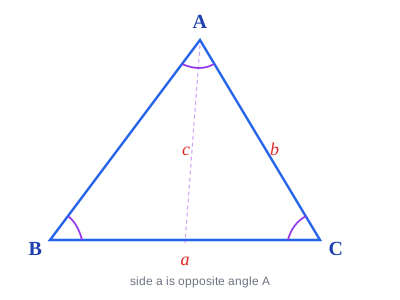
Labelling Convention
In any triangle, we use:
- Lowercase letters for sides: $a$, $b$, $c$
- Capital letters for angles: $A$, $B$, $C$
- The angle is opposite its matching side (angle $A$ is opposite side $a$)
The Sine Rule
$$\frac{a}{\sin A} = \frac{b}{\sin B} = \frac{c}{\sin C}$$
Use when you have: A matching pair (an angle and its opposite side) plus one other piece of information.
To find a side: Use $\frac{a}{\sin A} = \frac{b}{\sin B}$
To find an angle: Flip the rule: $\frac{\sin A}{a} = \frac{\sin B}{b}$
The Ambiguous Case (Finding Angles)
When finding an angle using the sine rule, there may be two possible answers because $\sin\theta = \sin(180° - \theta)$.
Check if both answers make sense by adding up all three angles — they must equal 180°.
The Cosine Rule
To find a side: $$a^2 = b^2 + c^2 - 2bc\cos A$$
To find an angle: $$\cos A = \frac{b^2 + c^2 - a^2}{2bc}$$
Use when you have: Either all three sides (finding an angle) OR two sides and the included angle (finding the third side).
Memory tip: The cosine rule looks like Pythagoras with an adjustment. If angle $A = 90°$, then $\cos 90° = 0$, and you get $a^2 = b^2 + c^2$.
Area of a Triangle
$$\text{Area} = \frac{1}{2}ab\sin C$$
In words: Half × (two sides) × sine of (included angle)
Use when you have: Two sides and the angle between them (the included angle).
Decision Tree
- Do you have a matching pair (angle with its opposite side)? → Use Sine Rule
- Do you have two sides and the included angle? → Use Cosine Rule (for third side) or Area Formula (for area)
- Do you have all three sides? → Use Cosine Rule (for any angle)
The Traps
Common misconceptions and how to avoid them.
Using the wrong trigonometric rule "The Rule Mix-Up"
The Mistake in Action
In triangle ABC, angle A = 50°, side b = 8cm, and side c = 10cm. Find side a.
Wrong: Using the sine rule: $\frac{a}{\sin 50°} = \frac{8}{\sin B}$
But we don't know angle B, so we're stuck.
Why It Happens
Students remember the sine rule is "easier" and try to use it without checking if they have the right information.
The Fix
Use the decision tree:
- Do you have a matching pair (angle + opposite side)? → Sine Rule
- Do you have two sides and the included angle? → Cosine Rule
In this problem: We have angle A (50°) and the two sides that include angle A (b and c). That's the cosine rule setup!
$$a^2 = b^2 + c^2 - 2bc\cos A$$ $$a^2 = 8^2 + 10^2 - 2(8)(10)\cos 50°$$ $$a^2 = 64 + 100 - 160(0.6428)$$ $$a^2 = 61.15...$$ $$a = 7.82\text{cm}$$
Spot the Mistake
In triangle ABC, angle A = 50°, side b = 8cm, side c = 10cm. Find side a.
Using the sine rule: $\frac{a}{\sin 50°} = \frac{8}{\sin B}$
Click on the line that contains the error.
Sign error in the cosine rule "The Sign Slip"
The Mistake in Action
Find side $a$ when $b = 7$, $c = 9$, and $A = 120°$.
Wrong: $a^2 = 7^2 + 9^2 - 2(7)(9)\cos 120°$ $a^2 = 49 + 81 - 126(-0.5)$ $a^2 = 130 - (-63)$ $a^2 = 67$ $a = 8.2\text{cm}$
Why It Happens
Students correctly identify $\cos 120° = -0.5$ but then make an error when handling the double negative.
The Fix
When $\cos A$ is negative (obtuse angle), the formula becomes: $$a^2 = b^2 + c^2 - 2bc \times (\text{negative})$$ $$a^2 = b^2 + c^2 + \text{positive number}$$
Correct working: $a^2 = 49 + 81 - 126(-0.5)$ $a^2 = 130 + 63 = 193$ $a = 13.9\text{cm}$
This makes sense: an obtuse angle opposite side $a$ means $a$ is the longest side.
Spot the Mistake
$a^2 = 7^2 + 9^2 - 2(7)(9)\cos 120°$
$a^2 = 130 - (-63) = 67$
$a = 8.2\text{cm}$
Click on the line that contains the error.
Using the wrong angle in the area formula "The Wrong Angle"
The Mistake in Action
Triangle PQR has PQ = 8cm, QR = 12cm, and angle P = 35°. Find the area.
Wrong: Area $= \frac{1}{2} \times 8 \times 12 \times \sin 35°$ Area $= 48 \times 0.574$ Area $= 27.5\text{cm}^2$
Why It Happens
Students use the area formula with any angle, not realising the angle must be between the two sides being used.
The Fix
The area formula is $\frac{1}{2}ab\sin C$, where angle $C$ is between sides $a$ and $b$.
In this problem:
- Sides used: PQ (8cm) and QR (12cm)
- These sides meet at point Q
- We need angle Q, not angle P!
You would need to:
- Use the sine rule to find another angle, OR
- Use cosine rule to find side PR, then use sine rule, OR
- Be given angle Q directly
Spot the Mistake
Triangle PQR has PQ = 8cm, QR = 12cm, angle P = 35°
Area $= \frac{1}{2} \times 8 \times 12 \times \sin 35°$
Click on the line that contains the error.
Ignoring the ambiguous case "The Missing Answer"
The Mistake in Action
In triangle ABC, a = 10cm, b = 15cm, and angle A = 40°. Find angle B.
Incomplete: $\frac{\sin B}{15} = \frac{\sin 40°}{10}$ $\sin B = \frac{15 \times \sin 40°}{10} = 0.964$ $B = \sin^{-1}(0.964) = 74.6°$
Why It Happens
Students find one answer and stop, forgetting that $\sin \theta = \sin(180° - \theta)$.
The Fix
When finding an angle using the sine rule, check for two possible answers.
$\sin B = 0.964$
First possibility: $B = 74.6°$ Second possibility: $B = 180° - 74.6° = 105.4°$
Check both work:
- If $B = 74.6°$: $A + B = 40° + 74.6° = 114.6°$ ✓ (leaves room for angle C)
- If $B = 105.4°$: $A + B = 40° + 105.4° = 145.4°$ ✓ (leaves $34.6°$ for angle C)
Both are valid! The triangle could have either shape.
When is there only one answer?
- When the second answer would make angles sum to more than 180°
- When you're finding an angle you know is acute or obtuse
Spot the Mistake
$\sin B = 0.964$
$B = 74.6°$
Click on the line that contains the error.
The Deep Dive
Apply your knowledge with these exam-style problems.
Level 1: Fully Worked
Complete solutions with commentary on each step.
Question
In triangle ABC, angle A = 42°, angle B = 73°, and side a = 15cm. Find the length of side b.
Solution
Step 1: Check we have a matching pair. Angle A and side a ✓ — we can use the sine rule.
Step 2: Write the sine rule for the sides we need. $$\frac{a}{\sin A} = \frac{b}{\sin B}$$
Step 3: Substitute the known values. $$\frac{15}{\sin 42°} = \frac{b}{\sin 73°}$$
Step 4: Rearrange and solve. $$b = \frac{15 \times \sin 73°}{\sin 42°}$$ $$b = \frac{15 \times 0.9563}{0.6691}$$ $$b = \frac{14.345}{0.6691}$$ $$b = 21.4\text{cm}$$ (3 s.f.)
Answer: b = 21.4 cm
Question
In triangle PQR, p = 8cm, q = 11cm, and angle P = 35°. Find angle Q.
Solution
Step 1: Set up the sine rule for angles. $$\frac{\sin Q}{q} = \frac{\sin P}{p}$$
Step 2: Substitute. $$\frac{\sin Q}{11} = \frac{\sin 35°}{8}$$
Step 3: Solve for sin Q. $$\sin Q = \frac{11 \times \sin 35°}{8} = \frac{11 \times 0.5736}{8} = 0.789$$
Step 4: Find angle Q. $$Q = \sin^{-1}(0.789) = 52.1°$$
Step 5: Check for ambiguous case. Second possibility: $Q = 180° - 52.1° = 127.9°$ Check: $P + Q = 35° + 127.9° = 162.9°$ — leaves $17.1°$ for R ✓
Both $Q = 52.1°$ and $Q = 127.9°$ are valid.
Answer: Q = 52.1° or Q = 127.9°
Question
In triangle XYZ, x = 5cm, y = 8cm, z = 10cm. Find angle Z.
Solution
Step 1: Write the cosine rule for the angle we want. $$\cos Z = \frac{x^2 + y^2 - z^2}{2xy}$$
Step 2: Substitute. $$\cos Z = \frac{5^2 + 8^2 - 10^2}{2 \times 5 \times 8}$$ $$\cos Z = \frac{25 + 64 - 100}{80}$$ $$\cos Z = \frac{-11}{80}$$ $$\cos Z = -0.1375$$
Step 3: Find the angle. $$Z = \cos^{-1}(-0.1375) = 97.9°$$
Check: The cosine is negative, which means the angle is obtuse (greater than 90°). This makes sense since side z (10cm) is the longest side.
Answer: Z = 97.9°
Question
Find the area of triangle ABC where a = 12cm, b = 9cm, and angle C = 48°.
Solution
Step 1: Identify what we have. Two sides (a and b) and the included angle (C — the angle between sides a and b). ✓
Step 2: Apply the area formula. $$\text{Area} = \frac{1}{2}ab\sin C$$
Step 3: Substitute and calculate. $$\text{Area} = \frac{1}{2} \times 12 \times 9 \times \sin 48°$$ $$\text{Area} = \frac{1}{2} \times 12 \times 9 \times 0.7431$$ $$\text{Area} = 54 \times 0.7431$$ $$\text{Area} = 40.1\text{cm}^2$$
Answer: Area = 40.1 cm²
Level 2: Scaffolded
Fill in the key steps.
Question
In triangle ABC, b = 7cm, c = 9cm, and angle A = 65°. Find side a.
Level 3: Solo
Try it yourself!
Question
A triangular field has sides AB = 120m and BC = 85m. Angle ABC = 72°. Find the area of the field and the length of the third side AC.
Show Solution
Part 1: Area
We have two sides (AB and BC) and the included angle (ABC).
$$\text{Area} = \frac{1}{2} \times 120 \times 85 \times \sin 72°$$ $$\text{Area} = \frac{1}{2} \times 120 \times 85 \times 0.9511$$ $$\text{Area} = 4851\text{m}^2$$
Part 2: Side AC
Using the cosine rule (two sides and included angle): $$AC^2 = AB^2 + BC^2 - 2 \times AB \times BC \times \cos 72°$$ $$AC^2 = 120^2 + 85^2 - 2 \times 120 \times 85 \times \cos 72°$$ $$AC^2 = 14400 + 7225 - 20400 \times 0.309$$ $$AC^2 = 21625 - 6304 = 15321$$ $$AC = 123.8\text{m}$$
Answers: Area = 4851 m², AC = 123.8 m
Examiner's View
Mark allocation: Sine Rule questions are typically 3-4 marks. Cosine Rule questions are 3-4 marks. Area formula is 2-3 marks. Combined problems can be 5-6 marks.
Common errors examiners see:
- Using the sine rule when the cosine rule is needed (and vice versa)
- Forgetting to label the triangle with correct convention
- Calculator in wrong mode (radians instead of degrees)
- In cosine rule: sign errors with the $-2bc\cos A$ term
- Finding the wrong angle (not the one asked for)
- In area formula: using two sides that don't include the given angle
What gains marks:
- Drawing and labelling the triangle clearly
- Stating which rule you're using
- Showing substitution into the formula
- For ambiguous case: checking both possible angles
- Giving answers to appropriate accuracy (usually 3 s.f. or 1 d.p.)
AQA Notes
AQA often embeds these in real-world contexts like surveying, navigation, or construction. Expect to draw your own diagrams from descriptions.