

Algebraic Fractions
The Skill
Algebraic fractions work just like numerical fractions, but with variables in the numerator, denominator, or both.
Simplifying Algebraic Fractions
To simplify, factorise the numerator and denominator, then cancel common factors.
Example: Simplify $\frac{6x^2}{9x}$
$$\frac{6x^2}{9x} = \frac{6 \times x \times x}{9 \times x} = \frac{2x}{3}$$
Example with factorising: Simplify $\frac{x^2 - 4}{x + 2}$
$$\frac{x^2 - 4}{x + 2} = \frac{(x+2)(x-2)}{x + 2} = x - 2$$
Adding and Subtracting Algebraic Fractions
Just like numerical fractions: find a common denominator, then add/subtract the numerators.
Example: $\frac{3}{x} + \frac{2}{x+1}$
Common denominator: $x(x+1)$
$$= \frac{3(x+1)}{x(x+1)} + \frac{2x}{x(x+1)} = \frac{3(x+1) + 2x}{x(x+1)}$$
$$= \frac{3x + 3 + 2x}{x(x+1)} = \frac{5x + 3}{x(x+1)}$$
Multiplying Algebraic Fractions
Multiply numerators together, multiply denominators together, then simplify.
$$\frac{a}{b} \times \frac{c}{d} = \frac{ac}{bd}$$
Tip: Cancel common factors before multiplying to keep numbers smaller.
Dividing Algebraic Fractions
Flip the second fraction and multiply (Keep, Change, Flip).
$$\frac{a}{b} \div \frac{c}{d} = \frac{a}{b} \times \frac{d}{c} = \frac{ad}{bc}$$
Solving Equations with Algebraic Fractions
Method 1: Multiply both sides by the denominator(s) to clear fractions.
Example: Solve $\frac{x+3}{4} = \frac{x-1}{2}$
Multiply both sides by 4: $$x + 3 = 2(x - 1)$$ $$x + 3 = 2x - 2$$ $$5 = x$$
Method 2: Cross-multiply (when you have one fraction on each side).
$$\frac{a}{b} = \frac{c}{d} \Rightarrow ad = bc$$
Cancelling Rules
The Traps
Common misconceptions and how to avoid them.
Cancelling terms instead of factors "The Term Terminator"
The Mistake in Action
Simplify $\frac{x + 4}{x}$
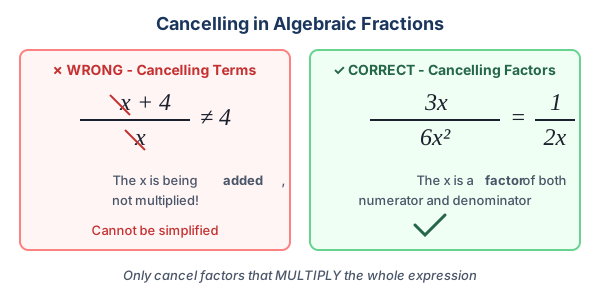
Wrong: $\frac{x + 4}{x} = \frac{\cancel{x} + 4}{\cancel{x}} = 4$
Why It Happens
Students see an $x$ on top and bottom and cancel them without realising you can only cancel factors that multiply the entire expression.
The Fix
You can only cancel something that multiplies everything in the numerator AND denominator.
In $\frac{x + 4}{x}$, the $x$ in the numerator is being added, not multiplied.
Correct: This fraction cannot be simplified further. $\frac{x + 4}{x}$ is the final answer.
When CAN you cancel? $\frac{3x}{6x^2} = \frac{3 \times x}{6 \times x \times x} = \frac{3}{6x} = \frac{1}{2x}$ ✓
Here the $x$ is a factor of both numerator and denominator.
Spot the Mistake
$\frac{x + 4}{x}$
$= \frac{\cancel{x} + 4}{\cancel{x}} = 4$
Click on the line that contains the error.
Not multiplying all terms when finding common denominator "The Missing Multiply"
The Mistake in Action
Simplify $\frac{3}{x} + \frac{2}{x+1}$
Wrong: $= \frac{3(x+1)}{x(x+1)} + \frac{2}{x(x+1)}$ $= \frac{3x + 3 + 2}{x(x+1)} = \frac{3x + 5}{x(x+1)}$
Why It Happens
When finding a common denominator, students multiply the numerator of one fraction but forget to multiply the other.
The Fix
Both fractions need their numerators multiplied by the appropriate factor.
$\frac{3}{x} + \frac{2}{x+1}$
Common denominator: $x(x+1)$
$= \frac{3(x+1)}{x(x+1)} + \frac{2 \times x}{x(x+1)}$
$= \frac{3x + 3 + 2x}{x(x+1)} = \frac{5x + 3}{x(x+1)}$
Spot the Mistake
$\frac{3(x+1)}{x(x+1)}$
$+ \frac{2}{x(x+1)}$
Click on the line that contains the error.
Cross-multiplying when adding fractions "The Cross-Multiply Confusion"
The Mistake in Action
Calculate $\frac{2}{x} + \frac{3}{y}$
Wrong: $= \frac{2y + 3x}{1}$ (cross-multiplied and added)
Why It Happens
Students confuse cross-multiplication (for equations) with finding common denominators (for adding fractions).
The Fix
Cross-multiplication is for solving equations like $\frac{a}{b} = \frac{c}{d}$ (giving $ad = bc$).
Adding fractions requires a common denominator:
$\frac{2}{x} + \frac{3}{y} = \frac{2y}{xy} + \frac{3x}{xy} = \frac{2y + 3x}{xy}$
The denominator does NOT disappear!
Spot the Mistake
$\frac{2}{x} + \frac{3}{y}$
$= \frac{2y + 3x}{1}$
Click on the line that contains the error.
Not factorising before cancelling "The Hasty Canceller"
The Mistake in Action
Simplify $\frac{x^2 - 9}{x + 3}$
Wrong: "This cannot be simplified because there's no common factor."
Why It Happens
Students look for obvious common factors without recognising that factorising the numerator would reveal a hidden factor.
The Fix
Always check if the numerator or denominator can be factorised.
$x^2 - 9$ is a difference of two squares!
$\frac{x^2 - 9}{x + 3} = \frac{(x+3)(x-3)}{x + 3} = x - 3$
Strategy: Always try to factorise before saying "cannot be simplified".
Spot the Mistake
$\frac{x^2 - 9}{x + 3}$
cannot be simplified
Click on the line that contains the error.
The Deep Dive
Apply your knowledge with these exam-style problems.
Level 1: Fully Worked
Complete solutions with commentary on each step.
Question
Simplify $\frac{12x^3}{18x}$
Solution
Step 1: Find the highest common factor of the numbers. HCF of 12 and 18 is 6.
Step 2: Find the highest power of x that divides both. Numerator has $x^3$, denominator has $x^1$. HCF is $x^1$.
Step 3: Divide both by the HCF. $$\frac{12x^3}{18x} = \frac{12x^3 \div 6x}{18x \div 6x} = \frac{2x^2}{3}$$
Answer: $\frac{2x^2}{3}$
Question
Simplify $\frac{x^2 + 5x}{x^2 + 7x + 10}$
Solution
Step 1: Factorise the numerator. $x^2 + 5x = x(x + 5)$
Step 2: Factorise the denominator. $x^2 + 7x + 10 = (x + 2)(x + 5)$
Step 3: Cancel common factors. $$\frac{x(x + 5)}{(x + 2)(x + 5)} = \frac{x}{x + 2}$$
Answer: $\frac{x}{x + 2}$
Question
Write as a single fraction: $\frac{2}{x} + \frac{5}{x + 3}$
Solution
Step 1: Find the common denominator. Common denominator = $x(x + 3)$
Step 2: Convert each fraction. $$\frac{2}{x} = \frac{2(x + 3)}{x(x + 3)} = \frac{2x + 6}{x(x + 3)}$$
$$\frac{5}{x + 3} = \frac{5x}{x(x + 3)}$$
Step 3: Add the numerators. $$\frac{2x + 6 + 5x}{x(x + 3)} = \frac{7x + 6}{x(x + 3)}$$
Answer: $\frac{7x + 6}{x(x + 3)}$
Level 2: Scaffolded
Fill in the key steps.
Question
Simplify $\frac{4}{x + 1} - \frac{2}{x - 1}$
Level 3: Solo
Try it yourself!
Question
Solve $\frac{x + 2}{3} = \frac{x - 1}{2}$
Show Solution
Method: Cross-multiply
$$2(x + 2) = 3(x - 1)$$ $$2x + 4 = 3x - 3$$ $$4 + 3 = 3x - 2x$$ $$7 = x$$
Check: LHS = $\frac{7 + 2}{3} = \frac{9}{3} = 3$ RHS = $\frac{7 - 1}{2} = \frac{6}{2} = 3$ ✓
Answer: $x = 7$
Question
Simplify $\frac{x^2 - 4}{x + 1} \times \frac{x + 1}{x - 2}$
Show Solution
Step 1: Factorise where possible. $x^2 - 4 = (x + 2)(x - 2)$
Step 2: Write out the multiplication. $$\frac{(x + 2)(x - 2)}{x + 1} \times \frac{x + 1}{x - 2}$$
Step 3: Cancel before multiplying. $$\frac{(x + 2)\cancel{(x - 2)}}{\cancel{x + 1}} \times \frac{\cancel{x + 1}}{\cancel{x - 2}}$$
$$= x + 2$$
Answer: $x + 2$
Examiner's View
Mark allocation: Simplifying is 2-3 marks. Adding/subtracting is 3-4 marks. Solving equations with fractions is 3-5 marks.
Common errors examiners see:
- Cancelling terms instead of factors (e.g., cancelling the x in $\frac{x+2}{x}$)
- Forgetting to expand brackets when finding common denominators
- Sign errors when subtracting fractions
- Not factorising before cancelling
What gains marks:
- Show factorisation clearly before cancelling
- Write the common denominator explicitly
- Check your answer by substituting a value
AQA Notes
AQA often embeds algebraic fractions in problem-solving contexts. You may need to form an equation first.