

Expanding Brackets and Factorising
The Skill
Expanding means removing brackets by multiplying. Factorising is the reverse — putting expressions into brackets.
Expanding Single Brackets
Multiply each term inside the bracket by the term outside.
$$3(x + 4) = 3x + 12$$
$$-2(y - 5) = -2y + 10$$
Watch out: A negative outside changes signs inside! $$-(a + b) = -a - b$$
Expanding Double Brackets
There are two main methods to expand double brackets. You can use whichever you find clearer.
Method 1: FOIL
Use the acronym FOIL: First, Outer, Inner, Last.
$$(x + 3)(x + 5)$$
- First: $x \times x = x^2$
- Outer: $x \times 5 = 5x$
- Inner: $3 \times x = 3x$
- Last: $3 \times 5 = 15$
Combine: $x^2 + 5x + 3x + 15 = x^2 + 8x + 15$
Method 2: Distributing Terms (Splitting the First Bracket)
This method involves treating the second bracket as a single item. You split the first bracket into separate terms and multiply each one by the entire second bracket. This is very useful because it works for more complex problems (like trinomials) where FOIL does not.
Step 1: Break the first bracket $(x + 3)$ into $x$ and $+3$.
Step 2: Write each term multiplying the second bracket $(x + 5)$.
$$(x + 3)(x + 5) = x(x + 5) + 3(x + 5)$$
Step 3: Expand the single brackets.
$$= x^2 + 5x + 3x + 15$$
Step 4: Collect like terms.
$$= x^2 + 8x + 15$$
Visualizing the Split: 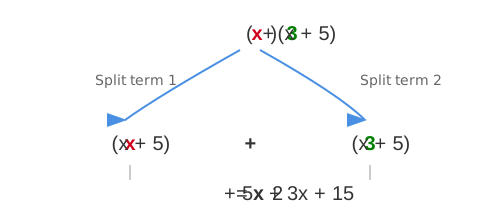
Factorising — Common Factor
Take out the highest common factor (HCF).
$$6x + 9 = 3(2x + 3)$$
$$x^2 + 5x = x(x + 5)$$
Factorising Quadratics (Higher)
For $x^2 + bx + c$, find two numbers that multiply to give $c$ and add to give $b$.
$$x^2 + 7x + 12 = (x + 3)(x + 4)$$
(since $3 \times 4 = 12$ and $3 + 4 = 7$)
Difference of Two Squares (Higher)
$$a^2 - b^2 = (a + b)(a - b)$$
Example: $x^2 - 25 = (x + 5)(x - 5)$
The Traps
Common misconceptions and how to avoid them.
Errors when expanding negative brackets "The Negative Neglect"
The Mistake in Action
Expand $-3(2x - 4)$
Wrong: $-6x - 12$
Why It Happens
Students correctly multiply -3 by 2x to get -6x, but then multiply -3 by -4 and keep it negative, forgetting that negative × negative = positive.
The Fix
Remember: When multiplying signs, same signs give positive, different signs give negative.
$$-3 \times 2x = -6x$$ (negative × positive = negative) $$-3 \times (-4) = +12$$ (negative × negative = positive)
Correct answer: $-6x + 12$
Spot the Mistake
Expand $-3(2x - 4)$
$-3 \times 2x = -6x$
$-3 \times (-4) = -12$
Click on the line that contains the error.
Not taking out the highest common factor "The Partial Factor"
The Mistake in Action
Factorise fully: $12x + 18$
Wrong: $2(6x + 9)$
Why It Happens
Students find a common factor but not the highest common factor. They stop too early.
The Fix
Always check if you can factor further!
$2(6x + 9)$ — Can we factor 6x + 9? Yes! Both are divisible by 3.
Better approach: Find the HCF of 12 and 18 first.
- HCF = 6
$$12x + 18 = 6(2x + 3)$$
Check: $6 \times 2x = 12x$ ✓, $6 \times 3 = 18$ ✓
Spot the Mistake
Factorise fully: $12x + 18$
$= 2(6x + 9)$
Click on the line that contains the error.
Thinking $(a + b)^2 = a^2 + b^2$ "The Binomial Blunder"
The Mistake in Action
Expand $(x + 3)^2$
Wrong: $x^2 + 9$
Why It Happens
Students "distribute" the square to each term inside, treating the brackets like multiplication distributes. But squaring is not multiplication by a number — $(x+3)^2$ means $(x+3)(x+3)$.
The Fix
$(x + 3)^2$ means $(x + 3)(x + 3)$
Use FOIL or remember the pattern: $$(a + b)^2 = a^2 + 2ab + b^2$$
Expanding: $$(x + 3)(x + 3) = x^2 + 3x + 3x + 9 = x^2 + 6x + 9$$
The middle term (2ab = 6x) is what's missing!
Spot the Mistake
Expand $(x + 3)^2$
$= x^2 + 9$
Click on the line that contains the error.
The Deep Dive
Apply your knowledge with these exam-style problems.
Level 1: Fully Worked
Complete solutions with commentary on each step.
Question
Expand and simplify: $4(2x + 3) - 3(x - 5)$
Solution
Step 1: Expand the first bracket $$4(2x + 3) = 8x + 12$$
Step 2: Expand the second bracket (watch the negative!) $$-3(x - 5) = -3x + 15$$
Step 3: Combine $$8x + 12 - 3x + 15$$
Step 4: Simplify by collecting like terms $$= 5x + 27$$
Answer: $5x + 27$
Question
Expand $(x + 4)(x - 2)$
Solution
Using FOIL:
First: $x \times x = x^2$ Outer: $x \times (-2) = -2x$ Inner: $4 \times x = 4x$ Last: $4 \times (-2) = -8$
Combine: $$x^2 - 2x + 4x - 8$$
Simplify: $$= x^2 + 2x - 8$$
Answer: $x^2 + 2x - 8$
Question
Factorise $x^2 + 5x - 14$
Solution
We need two numbers that:
- Multiply to give -14
- Add to give +5
Factor pairs of -14:
- $1 \times (-14) = -14$, sum = $-13$ ✗
- $(-1) \times 14 = -14$, sum = $13$ ✗
- $2 \times (-7) = -14$, sum = $-5$ ✗
- $(-2) \times 7 = -14$, sum = $5$ ✓
The numbers are -2 and 7.
$$x^2 + 5x - 14 = (x - 2)(x + 7)$$
Check by expanding: $(x-2)(x+7) = x^2 + 7x - 2x - 14 = x^2 + 5x - 14$ ✓
Answer: $(x - 2)(x + 7)$
Level 2: Scaffolded
Fill in the key steps.
Question
Factorise fully: $15x^2 - 10x$
Level 3: Solo
Try it yourself!
Question
Factorise $x^2 - 49$
Show Solution
This is a difference of two squares: $a^2 - b^2 = (a+b)(a-b)$
Here: $a = x$ and $b = 7$ (since $49 = 7^2$)
$$x^2 - 49 = (x + 7)(x - 7)$$
Check: $(x+7)(x-7) = x^2 - 7x + 7x - 49 = x^2 - 49$ ✓
Answer: $(x + 7)(x - 7)$
Examiner's View
Mark allocation: Single bracket expansion is 1 mark. Double brackets is 2 marks. Factorising quadratics is 2-3 marks.
Common errors examiners see:
- Sign errors, especially with negatives
- Missing the middle terms in double bracket expansion
- Not fully factorising (stopping too early)
- Forgetting to check by expanding back
What gains marks:
- Showing all four terms before simplifying (for FOIL)
- Writing down the factor pairs you're testing
- Checking by expanding your factorised answer
AQA Notes
AQA often asks "expand and simplify" which means combine like terms after expanding.