

Vectors H
The Skill
A vector describes a movement with both direction and magnitude (length).
Notation
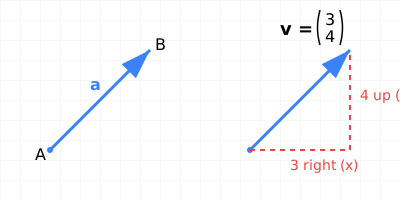
Vectors can be written as:
- Bold letter: $\mathbf{a}$
- Underlined letter: $\underline{a}$ (used in handwriting)
- Start and end point: $\vec{AB}$ (vector from A to B)
Column Vectors
A column vector describes movement in $x$ (top) and $y$ (bottom): $$\mathbf{a} = \begin{pmatrix} x \\ y \end{pmatrix}$$
- Top number: Right (positive) or Left (negative)
- Bottom number: Up (positive) or Down (negative)
Vector Arithmetic
Adding/Subtracting: Add or subtract the top and bottom numbers separately. $$\begin{pmatrix} 2 \\ 3 \end{pmatrix} + \begin{pmatrix} 4 \\ -1 \end{pmatrix} = \begin{pmatrix} 6 \\ 2 \end{pmatrix}$$
Multiplying by a Scalar: Multiply both numbers by the scalar (number). $$3 \begin{pmatrix} 2 \\ -5 \end{pmatrix} = \begin{pmatrix} 6 \\ -15 \end{pmatrix}$$
Geometric Problems
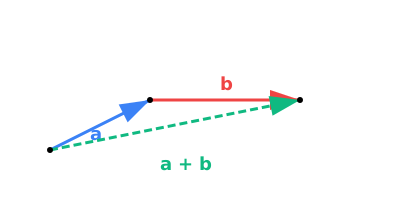
To get from one point to another, you can follow any path. $$\vec{AC} = \vec{AB} + \vec{BC}$$
Opposite Direction: If $\vec{AB} = \mathbf{a}$, then $\vec{BA} = -\mathbf{a}$.
Geometric Proofs

1. Proving lines are parallel: Two vectors are parallel if one is a scalar multiple of the other.
- Example: If $\vec{AB} = 2\mathbf{a} + \mathbf{b}$ and $\vec{CD} = 6\mathbf{a} + 3\mathbf{b}$
- $\vec{CD} = 3(2\mathbf{a} + \mathbf{b}) = 3\vec{AB}$
- Therefore, $\vec{CD}$ is parallel to $\vec{AB}$ (and 3 times longer).
2. Proving points are collinear: Points A, B, and C are collinear (lie on the same straight line) if:
- $\vec{AB}$ is parallel to $\vec{BC}$ (one is a multiple of the other)
- They share a common point (B)
The Traps
Common misconceptions and how to avoid them.
Ignoring direction (negative signs) "The One-Way Street"
The Mistake in Action
In a triangle $OAB$, $\vec{OA} = \mathbf{a}$ and $\vec{OB} = \mathbf{b}$. Find $\vec{AB}$.
Wrong: $\vec{AB} = \mathbf{a} + \mathbf{b}$
Why It Happens
Students look at the letters $\mathbf{a}$ and $\mathbf{b}$ and just add them, ignoring the arrows on the diagram. They forget that to go from A to B, they must go against the arrow for $\mathbf{a}$.
The Fix
To go from A to B via O:
- Start at A, go to O: This is against the arrow, so $-\mathbf{a}$.
- Go from O to B: This is with the arrow, so $+\mathbf{b}$.
$$\vec{AB} = -\mathbf{a} + \mathbf{b} = \mathbf{b} - \mathbf{a}$$
Spot the Mistake
Find vector AB given OA=a and OB=b
Path is A to O to B
AB = a + b
= b - a
Click on the line that contains the error.
Writing column vectors as fractions "The Fraction Habit"
The Mistake in Action
Write the vector $\mathbf{a} = \begin{pmatrix} 3 \\ 4 \end{pmatrix}$
Wrong: $\mathbf{a} = (\frac{3}{4})$
Why It Happens
Students are used to seeing one number over another as a fraction and instinctively draw a line between them.
The Fix
A column vector is not a fraction. It represents movement in x and y.
Never put a horizontal line between the numbers.
Correct: $\begin{pmatrix} 3 \\ 4 \end{pmatrix}$
Spot the Mistake
Write vector a
a = (3/4)
Click on the line that contains the error.
Confusing parallel with collinear "The Parallel Pitfall"
The Mistake in Action
Prove A, B, and C are collinear. Student shows $\vec{AB} = 2\mathbf{a}$ and $\vec{CD} = 4\mathbf{a}$. Conclusion: "They are collinear."
Why It Happens
Students successfully prove the vectors are parallel but apply the wrong terminology or logic. Collinear means "on the same line", not just parallel.
The Fix
To prove Collinear:
- Show vectors are parallel (e.g. $\vec{AC} = 2\vec{AB}$)
- State that they share a common point (B).
Without the common point, the lines could just be parallel like train tracks.
Spot the Mistake
Prove A, B, C are collinear
AB = a + b, BC = 2(a + b)
Vectors are parallel, so points are collinear
Click on the line that contains the error.
The Deep Dive
Apply your knowledge with these exam-style problems.
Level 1: Fully Worked
Complete solutions with commentary on each step.
Question
Given $\mathbf{a} = \begin{pmatrix} 2 \\ -3 \end{pmatrix}$ and $\mathbf{b} = \begin{pmatrix} 4 \\ 1 \end{pmatrix}$, calculate the vector $3\mathbf{a} - \mathbf{b}$.
Solution
Step 1: Multiply a by the scalar 3. $$3\mathbf{a} = 3 \begin{pmatrix} 2 \\ -3 \end{pmatrix} = \begin{pmatrix} 3 \times 2 \\ 3 \times -3 \end{pmatrix} = \begin{pmatrix} 6 \\ -9 \end{pmatrix}$$
Step 2: Subtract vector b. $$\begin{pmatrix} 6 \\ -9 \end{pmatrix} - \begin{pmatrix} 4 \\ 1 \end{pmatrix} = \begin{pmatrix} 6 - 4 \\ -9 - 1 \end{pmatrix}$$
Step 3: Calculate the final components. $$\begin{pmatrix} 2 \\ -10 \end{pmatrix}$$
Answer: $\begin{pmatrix} 2 \\ -10 \end{pmatrix}$
Question
$OAB$ is a triangle. $\vec{OA} = \mathbf{a}$ and $\vec{OB} = \mathbf{b}$. $M$ is the midpoint of $AB$.
Find $\vec{OM}$ in terms of $\mathbf{a}$ and $\mathbf{b}$. Give your answer in its simplest form.
Solution
Step 1: Find the vector path for $\vec{AB}$. To go from A to B, we go against $\mathbf{a}$ and with $\mathbf{b}$. $$\vec{AB} = \vec{AO} + \vec{OB} = -\mathbf{a} + \mathbf{b}$$
Step 2: Find the vector for $\vec{AM}$. Since M is the midpoint, $\vec{AM}$ is half of $\vec{AB}$. $$\vec{AM} = \frac{1}{2}\vec{AB} = \frac{1}{2}(-\mathbf{a} + \mathbf{b})$$
Step 3: Find $\vec{OM}$ by adding paths. We can reach M from O by going O $\to$ A $\to$ M. $$\vec{OM} = \vec{OA} + \vec{AM}$$ $$\vec{OM} = \mathbf{a} + \frac{1}{2}(-\mathbf{a} + \mathbf{b})$$
Step 4: Simplify. $$\vec{OM} = \mathbf{a} - \frac{1}{2}\mathbf{a} + \frac{1}{2}\mathbf{b}$$ $$\vec{OM} = \frac{1}{2}\mathbf{a} + \frac{1}{2}\mathbf{b}$$
Answer: $\frac{1}{2}(\mathbf{a} + \mathbf{b})$
Level 2: Scaffolded
Fill in the key steps.
Question
$OACB$ is a parallelogram where $\vec{OA} = \mathbf{a}$ and $\vec{OB} = \mathbf{b}$.
Point $P$ lies on the diagonal $OC$ such that $OP:PC = 2:1$.
Find $\vec{AP}$ in terms of $\mathbf{a}$ and $\mathbf{b}$.
Level 3: Solo
Try it yourself!
Question
$\vec{OA} = 2\mathbf{a} + 3\mathbf{b}$ and $\vec{OB} = 3\mathbf{a} + 4.5\mathbf{b}$.
Prove that points O, A, and B lie on a straight line.
Show Solution
Step 1: Factorise the vectors.
$\vec{OA} = 2\mathbf{a} + 3\mathbf{b}$
$\vec{OB} = 3\mathbf{a} + 4.5\mathbf{b} = 1.5(2\mathbf{a} + 3\mathbf{b})$
Step 2: Compare them. We can see that $\vec{OB} = 1.5 \times \vec{OA}$.
Step 3: Conclusion. Since $\vec{OB}$ is a scalar multiple of $\vec{OA}$, the vectors are parallel (they have the same direction).
Since both vectors share a common point (O), the points O, A, and B must be collinear (lie on the same straight line).
Examiner's View
Mark allocation: Column vector arithmetic is usually 1-2 marks. Geometric proofs are 4-5 marks.
Common errors examiners see:
- Forgetting the negative sign when going "against" the arrow direction.
- In column vectors, treating the numbers like a fraction (adding a line).
- Not stating "common point" when proving collinearity.
What gains marks:
- Clearly stating the path you are taking (e.g., $\vec{XY} = {XA} + \vec{AY}$).
- Factoring out the scalar to show vectors are parallel.
- Writing a concluding sentence for proofs ("Therefore parallel...").
AQA Notes
AQA often uses regular hexagons for vector geometry questions. Remember that the path from center to edge equals the side length.