

Compound Interest and Depreciation
The Skill
Compound interest and depreciation involve repeated percentage changes over time.
Simple vs Compound Interest
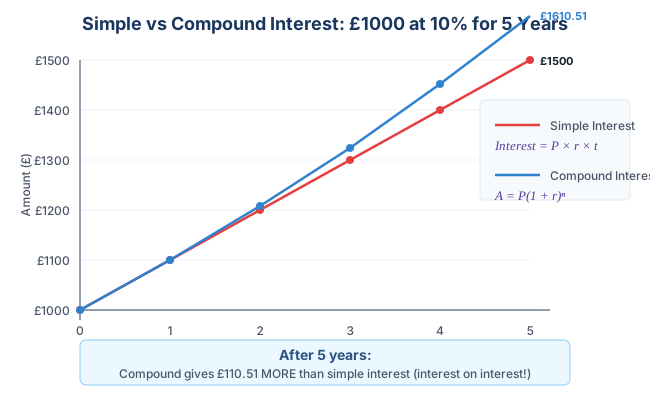
Simple interest: Interest is calculated only on the original amount.
Compound interest: Interest is calculated on the original amount PLUS any interest already earned.
The Compound Interest Formula
$$\text{Final Amount} = P\left(1 + \frac{r}{100}\right)^n$$
Where:
- $P$ = Principal (starting amount)
- $r$ = Interest rate per period (as a percentage)
- $n$ = Number of time periods
Example: £2000 is invested at 5% compound interest per year for 3 years.
$$\text{Amount} = 2000 \times (1.05)^3 = 2000 \times 1.157625 = £2315.25$$
Depreciation
Depreciation is when something loses value over time.
$$\text{Final Value} = P\left(1 - \frac{r}{100}\right)^n$$
Note the minus sign inside the bracket!
Example: A car worth £12,000 depreciates by 15% each year for 4 years.
$$\text{Value} = 12000 \times (0.85)^4 = 12000 \times 0.52200625 = £6264.08$$
Finding the Original Amount
Rearrange the formula to solve for $P$:
$$P = \frac{\text{Final Amount}}{\left(1 \pm \frac{r}{100}\right)^n}$$
Example: After 2 years at 8% compound interest, an investment is worth £1166.40. Find the original amount.
$$P = \frac{1166.40}{(1.08)^2} = \frac{1166.40}{1.1664} = £1000$$
Finding the Rate or Time
To find the rate: May need trial and improvement or nth roots.
To find the time: Use trial and improvement or logarithms (higher only).
Example: £500 grows to £600 in 4 years. Find the interest rate.
$$600 = 500 \times (1 + r)^4$$ $$1.2 = (1 + r)^4$$ $$1 + r = \sqrt[4]{1.2} = 1.0466...$$ $$r = 0.0466... = 4.66\%$$
Multiplier Approach
The multiplier makes calculations easier:
| Change | Multiplier |
|---|---|
| 5% increase | 1.05 |
| 12% increase | 1.12 |
| 5% decrease | 0.95 |
| 20% decrease | 0.80 |
For compound changes, multiply the multipliers: $$\text{Final} = \text{Original} \times (\text{multiplier})^n$$
Growth Comparison
The Traps
Common misconceptions and how to avoid them.
Using simple interest formula for compound interest "The Simple Mistake"
The Mistake in Action
£1000 is invested at 5% compound interest for 3 years. Find the final amount.
Wrong: Interest per year = $1000 \times 0.05 = £50$ Total interest = $50 \times 3 = £150$ Final amount = $1000 + 150 = £1150$
Why It Happens
Students calculate interest on the original amount each year, not realising compound interest builds on previous interest.
The Fix
With compound interest, each year's interest is added before calculating the next year's interest.
Year 1: $1000 \times 1.05 = £1050$ Year 2: $1050 \times 1.05 = £1102.50$ Year 3: $1102.50 \times 1.05 = £1157.63$
Or use the formula: $1000 \times (1.05)^3 = £1157.63$
Difference: Compound gives £7.63 more than simple interest.
Spot the Mistake
£1000 at 5% for 3 years
Interest = $50 \times 3 = £150$
Click on the line that contains the error.
Using 1 + r instead of 1 - r for depreciation "The Depreciation Direction"
The Mistake in Action
A car worth £15,000 depreciates by 12% per year for 2 years.
Wrong: $15000 \times (1.12)^2 = £18,816$
Why It Happens
Students use the compound interest multiplier (1 + r) instead of the depreciation multiplier (1 − r).
The Fix
Depreciation means losing value, so the multiplier is less than 1.
For 12% depreciation: multiplier = $1 - 0.12 = 0.88$
Correct calculation: $15000 \times (0.88)^2 = 15000 \times 0.7744 = £11,616$
Check: The value should go DOWN, not up!
Spot the Mistake
Depreciates by 12%
$15000 \times (1.12)^2$
Click on the line that contains the error.
Forgetting to convert percentage to decimal "The Percentage Slip"
The Mistake in Action
Find the value of £500 after 4 years at 8% compound interest.
Wrong: $500 \times (1 + 8)^4 = 500 \times 9^4 = 3,280,500$
Why It Happens
Students put the percentage directly into the formula without dividing by 100.
The Fix
The formula uses $\frac{r}{100}$ to convert the percentage to a decimal.
8% = 0.08, so multiplier = $1 + 0.08 = 1.08$
Correct: $500 \times (1.08)^4 = 500 \times 1.3605 = £680.24$
Quick check: Your answer should be reasonable. £3 million from £500 is clearly wrong!
Spot the Mistake
8% compound interest
$(1 + 8)^4 = 9^4$
Click on the line that contains the error.
Subtracting interest to find original amount "The Reverse Mistake"
The Mistake in Action
After 3 years at 6% compound interest, an investment is worth £1191.02. Find the original amount.
Wrong: $1191.02 - (0.06 \times 3 \times 1191.02) = 1191.02 - 214.38 = £976.64$
Why It Happens
Students try to "undo" compound interest by calculating and subtracting interest, but this uses simple interest logic.
The Fix
To reverse compound interest, divide by the multiplier raised to the power.
$$P = \frac{\text{Final}}{(1 + r)^n} = \frac{1191.02}{(1.06)^3}$$
$$P = \frac{1191.02}{1.191016} = £1000$$
Key insight: Dividing reverses multiplication, just as the multiplier was applied by multiplication.
Spot the Mistake
Find original from £1191.02 after 3 years at 6%
$1191.02 - (0.06 \times 3 \times 1191.02)$
Click on the line that contains the error.
The Deep Dive
Apply your knowledge with these exam-style problems.
Level 1: Fully Worked
Complete solutions with commentary on each step.
Question
£3000 is invested at 4% compound interest per year for 5 years. Find the final amount.
Solution
Using the formula: $A = P(1 + \frac{r}{100})^n$
Where:
- $P = £3000$ (principal)
- $r = 4$ (rate)
- $n = 5$ (years)
$$A = 3000 \times (1 + \frac{4}{100})^5$$ $$A = 3000 \times (1.04)^5$$ $$A = 3000 \times 1.2166529...$$ $$A = £3649.96$$
Answer: £3649.96 (or £3650 to the nearest pound)
Question
A car is bought for £18,500. It depreciates by 12% each year. What is it worth after 4 years?
Solution
Using the depreciation formula: $V = P(1 - \frac{r}{100})^n$
Where:
- $P = £18,500$
- $r = 12$ (depreciation rate)
- $n = 4$ (years)
$$V = 18500 \times (1 - \frac{12}{100})^4$$ $$V = 18500 \times (0.88)^4$$ $$V = 18500 \times 0.59969536$$ $$V = £11094.36$$
Answer: £11,094.36 (or £11,094 to the nearest pound)
The car has lost £18,500 − £11,094 = £7,406 in value.
Question
After 3 years at 5% compound interest, an investment is worth £2315.25. Find the original investment.
Solution
Rearranging the formula: $$P = \frac{A}{(1 + \frac{r}{100})^n}$$
$$P = \frac{2315.25}{(1.05)^3}$$
$$P = \frac{2315.25}{1.157625}$$
$$P = £2000$$
Check: $2000 \times 1.05^3 = 2000 \times 1.157625 = 2315.25$ ✓
Answer: The original investment was £2000
Level 2: Scaffolded
Fill in the key steps.
Question
£5000 is invested for 4 years. Compare the interest earned with: (a) 6% simple interest (b) 6% compound interest
Level 3: Solo
Try it yourself!
Question
An investment of £800 grows to £926.10 over 3 years with compound interest. Find the annual interest rate.
Show Solution
Set up the equation: $$926.10 = 800 \times (1 + r)^3$$
Solve for (1 + r): $$\frac{926.10}{800} = (1 + r)^3$$ $$1.157625 = (1 + r)^3$$
Take the cube root: $$1 + r = \sqrt[3]{1.157625}$$ $$1 + r = 1.05$$ $$r = 0.05$$
Convert to percentage: $$r = 5\%$$
Check: $800 \times 1.05^3 = 800 \times 1.157625 = 926.10$ ✓
Answer: The interest rate is 5% per year
Question
A laptop worth £1200 depreciates by 25% in the first year and 15% each year after that. What is it worth after 3 years?
Show Solution
This is a multi-stage depreciation problem.
After Year 1 (25% depreciation): $1200 \times 0.75 = £900$
After Year 2 (15% depreciation): $900 \times 0.85 = £765$
After Year 3 (15% depreciation): $765 \times 0.85 = £650.25$
Alternative calculation: $1200 \times 0.75 \times 0.85^2 = 1200 \times 0.75 \times 0.7225 = £650.25$
Answer: £650.25 (or £650 to the nearest pound)
Examiner's View
Mark allocation: Basic compound interest is 2-3 marks. Reverse problems (finding original amount) are 3-4 marks.
Common errors examiners see:
- Using the simple interest formula
- Forgetting to convert percentage to decimal
- Using addition instead of multiplication
- Subtracting instead of using 1 − r for depreciation
What gains marks:
- Show the formula you're using
- Write the multiplier clearly
- Give answers to a sensible degree of accuracy (usually 2 d.p. for money)
- Check the answer makes sense
AQA Notes
AQA may ask you to compare simple and compound interest.