

Circle Theorems H
The Skill
Circle theorems are rules about angles and lines in circles. Higher tier only.
Key Vocabulary
- Chord: A line segment with both endpoints on the circle
- Arc: Part of the circumference
- Tangent: A line that touches the circle at exactly one point
- Sector: A "pizza slice" shape (two radii and an arc)
- Segment: The region between a chord and an arc
Theorem 1: Angle at the Centre
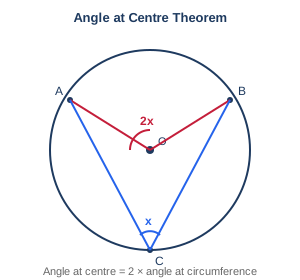
The angle at the centre is twice the angle at the circumference (when subtended by the same arc).
$$\text{Angle at centre} = 2 \times \text{Angle at circumference}$$
Theorem 2: Angles in the Same Segment
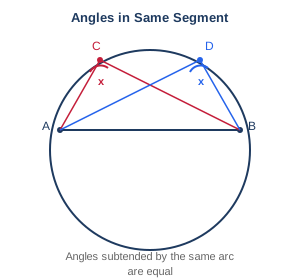
Angles subtended by the same arc (in the same segment) are equal.
Theorem 3: Angle in a Semicircle
The angle in a semicircle is always 90°.
(This is a special case of Theorem 1: angle at centre = 180°, so angle at circumference = 90°)
Theorem 4: Cyclic Quadrilateral
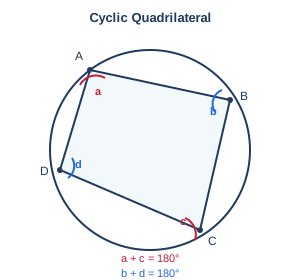
A cyclic quadrilateral has all four vertices on the circle.
Opposite angles add up to 180°.
$$a + c = 180° \quad \text{and} \quad b + d = 180°$$
Theorem 5: Tangent and Radius
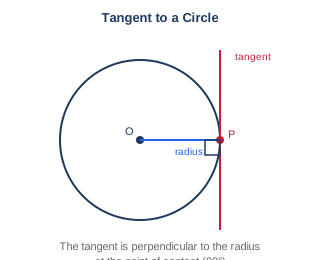
A tangent is perpendicular to the radius at the point of contact.
Theorem 6: Two Tangents from a Point
Tangents from an external point to a circle are equal in length.
Theorem 7: Alternate Segment Theorem
The angle between a tangent and a chord equals the angle in the alternate segment.
The Traps
Common misconceptions and how to avoid them.
Adding adjacent instead of opposite angles in cyclic quadrilateral "The Adjacent Angle Error"
The Mistake in Action
ABCD is a cyclic quadrilateral. Angle A = 75°. Find angle B.
Wrong: Angle B = 180° - 75° = 105°
Why It Happens
Students correctly remember that angles add to 180° but apply this to adjacent angles instead of opposite angles.
The Fix
In a cyclic quadrilateral, OPPOSITE angles sum to 180°.
A is opposite to C, and B is opposite to D.
If angle A = 75°:
- Angle C = 180° - 75° = 105° ✓
- Angle B cannot be found from angle A alone (they're adjacent, not opposite)
Memory aid: Draw diagonal lines connecting opposite corners to remind yourself which pairs add to 180°.
Spot the Mistake
ABCD cyclic quad, angle A = 75°
Angle B = 180° - 75° = 105°
Click on the line that contains the error.
Forgetting tangent-radius is 90° "The Right Angle Oversight"
The Mistake in Action
PT is a tangent to the circle at T. O is the centre. Angle OPT = 35°. Find angle POT.
Wrong: Cannot be found without more information.
Why It Happens
Students don't automatically recognise that tangent-radius creates a right angle, so they think they don't have enough information.
The Fix
Key fact: The angle between a tangent and radius is always 90° at the point of contact.
In triangle OPT:
- Angle OTP = 90° (tangent ⊥ radius)
- Angle OPT = 35° (given)
- Angle POT = 180° - 90° - 35° = 55°
Always look for tangent lines — they create right angles with the radius!
Spot the Mistake
PT is tangent at T, angle OPT = 35°
Cannot be found
Click on the line that contains the error.
Halving instead of doubling for angle at centre "The Half-Double Confusion"
The Mistake in Action
Angle ACB (at circumference) = 50°. Find angle AOB (at centre).
Wrong: Angle AOB = 50° ÷ 2 = 25°
Why It Happens
Students remember there's a factor of 2 involved but apply it the wrong way round. They halve when they should double.
The Fix
Angle at centre = 2 × angle at circumference
The angle at the centre is the bigger one. Think of it as the centre having the "full view" of the arc.
Angle ACB = 50° (at circumference) Angle AOB = 50° × 2 = 100° (at centre)
Memory aid: "Centre sees more" — double it!
Spot the Mistake
Angle ACB (circumference) = 50°
Angle AOB = 50° ÷ 2 = 25°
Click on the line that contains the error.
The Deep Dive
Apply your knowledge with these exam-style problems.
Level 1: Fully Worked
Complete solutions with commentary on each step.
Question
O is the centre of the circle. A, B, and C are points on the circumference. Angle ACB = 42°. Find angle AOB.
Solution
Identify the theorem: Both angles are subtended by arc AB, with one at the centre (O) and one at the circumference (C).
Apply the theorem: Angle at centre = 2 × angle at circumference
$$\text{Angle AOB} = 2 \times 42° = 84°$$
Answer: Angle AOB = 84°
Question
AB is a diameter of the circle. C is a point on the circumference. Angle CAB = 37°. Find angle ABC.
Solution
Key fact: The angle in a semicircle is 90°.
Since AB is a diameter, angle ACB = 90° (angle in a semicircle).
Angles in a triangle sum to 180°: $$\text{Angle ABC} = 180° - 90° - 37° = 53°$$
Answer: Angle ABC = 53°
Question
PT is a tangent to the circle, touching at T. O is the centre. OT = 5 cm and OP = 13 cm. Find the length PT.
Solution
Key fact: Tangent is perpendicular to radius at point of contact.
So angle OTP = 90°, and triangle OTP is right-angled at T.
Using Pythagoras: $$OP^2 = OT^2 + PT^2$$ $$13^2 = 5^2 + PT^2$$ $$169 = 25 + PT^2$$ $$PT^2 = 144$$ $$PT = 12 \text{ cm}$$
Answer: PT = 12 cm
Level 2: Scaffolded
Fill in the key steps.
Question
PQRS is a cyclic quadrilateral. Angle P = 82° and angle Q = 75°. Find angles R and S.
Level 3: Solo
Try it yourself!
Question
O is the centre. A, B, C, D are on the circumference. Angle AOC = 124° (reflex angle). Find angle ABC.
Show Solution
Step 1: Find the non-reflex angle AOC. Reflex angle AOC = 124°? That seems wrong — 124° is not reflex. Let me assume angle AOC (the one going the long way) = 124°, so the minor angle AOC = 360° - 124° = 236°.
Actually, let's reconsider: if reflex angle AOC = 236°, then minor angle AOC = 360° - 236° = 124°.
Step 2: Use angle at centre = 2 × angle at circumference. The angle ABC is at the circumference, standing on the same arc AC as angle AOC at the centre.
If we use the minor arc (124° at centre): $$\text{Angle ABC} = \frac{124°}{2} = 62°$$
But if angle ABC stands on the major arc, we use the reflex angle: $$\text{Angle ABC} = \frac{236°}{2} = 118°$$
[The answer depends on which arc ABC subtends — check the diagram carefully]
Most likely answer: 62° (if ABC is in the major segment)
Examiner's View
Mark allocation: Each theorem application is typically 2-3 marks. Multi-step problems are 4-5 marks.
Common errors examiners see:
- Using the wrong theorem
- Forgetting that tangent-radius is 90°
- Not recognising a cyclic quadrilateral
- Confusing "same segment" with "same arc"
What gains marks:
- State the theorem you are using
- Show clear working
- Give reasons for each step
- Use correct terminology
AQA Notes
AQA often asks you to prove one of the theorems. Practise the proofs!