
Bearings
The Skill
A bearing is a way of describing direction using angles.
How Bearings Work
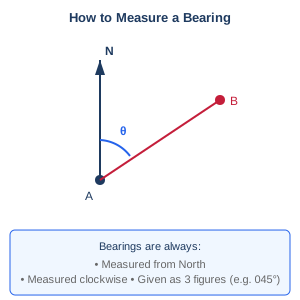
Three rules for bearings:
- Always measure from North
- Always measure clockwise
- Always write as three figures (e.g., 045° not 45°)
Common Bearings
| Direction | Bearing |
|---|---|
| North | 000° |
| East | 090° |
| South | 180° |
| West | 270° |
| NE | 045° |
| SE | 135° |
| SW | 225° |
| NW | 315° |
Finding a Bearing
Bearing of B from A means: stand at A, face North, turn clockwise until you face B.
Back Bearings
The back bearing (bearing of A from B) is related to the forward bearing:
- If forward bearing < 180°: back bearing = forward + 180°
- If forward bearing ≥ 180°: back bearing = forward - 180°
Example: Bearing of B from A is 070°. Back bearing (A from B) = 070° + 180° = 250°
Bearings with Trigonometry
Often combined with sine/cosine rules or SOH CAH TOA:
- Draw a clear diagram with North lines
- Mark the bearing angles
- Find angles in the triangle
- Use trig to find distances or angles
The Traps
Common misconceptions and how to avoid them.
Confusing "bearing of A from B" with "bearing of B from A" "The From Confusion"
The Mistake in Action
Find the bearing of A from B.
Wrong: Stands at A and measures angle to B.
Why It Happens
The phrase "bearing of A from B" is counterintuitive — students think it means "from A to B" rather than "standing at B, looking toward A".
The Fix
"Bearing of A from B" means:
- Stand at B
- Face North
- Turn clockwise until facing A
- That angle is the bearing
Memory aid: The second place is where you stand. "Bearing of A from B" = you are at B, looking toward A.
Think: "Of → To, From → At"
Spot the Mistake
Find bearing of A from B
Stands at A and measures to B
Click on the line that contains the error.
Measuring anticlockwise instead of clockwise "The Wrong Direction"
The Mistake in Action
The angle from North to the direction of B (going anticlockwise) is 60°. State the bearing.
Wrong: Bearing = 060°
Why It Happens
Students measure the angle correctly but go anticlockwise, or they don't realise bearings must always be measured clockwise.
The Fix
Bearings are always measured clockwise from North.
If the anticlockwise angle is 60°, then the clockwise angle (the bearing) is: $$360° - 60° = 300°$$
Bearing = 300°
Visual check: East is 090°, so anything between North and East should be between 000° and 090°. If your answer doesn't fit where the direction actually points, check your direction!
Spot the Mistake
Anticlockwise angle from North = 60°
Bearing = 060°
Click on the line that contains the error.
Not using three figures for bearings "The Missing Zero"
The Mistake in Action
The bearing of B from A is 45°.
Why It Happens
Students write the mathematically correct angle but forget that bearings are conventionally written with three digits.
The Fix
Bearings must always be written with three figures.
Add leading zeros if needed:
- 5° → 005°
- 45° → 045°
- 90° → 090°
Only bearings from 100° to 360° naturally have three digits.
Why? It avoids confusion and is the standard convention for navigation.
Spot the Mistake
The bearing is
45°
Click on the line that contains the error.
The Deep Dive
Apply your knowledge with these exam-style problems.
Level 1: Fully Worked
Complete solutions with commentary on each step.
Question
North points directly up. Point B is 50° clockwise from North as seen from point A. State the bearing of B from A.
Solution
Step 1: Confirm we're measuring from North, clockwise. The angle is 50° clockwise from North ✓
Step 2: Write as three figures. 50° → 050°
Answer: The bearing of B from A is 050°
Question
The bearing of B from A is 125°. Find the bearing of A from B.
Solution
Method: Back bearings differ by 180°.
Since 125° < 180°, add 180°: $$\text{Back bearing} = 125° + 180° = 305°$$
Answer: The bearing of A from B is 305°
Check: The directions should be opposite. 125° is roughly SE; 305° is roughly NW ✓
Question
A ship sails 8 km from A on a bearing of 040°. How far North and how far East of A is the ship?
Solution
Draw a right-angled triangle:
- The 8 km journey is the hypotenuse
- North component is adjacent to the 40° angle
- East component is opposite to the 40° angle
North component (adjacent): $$\cos(40°) = \frac{\text{North}}{8}$$ $$\text{North} = 8 \times \cos(40°) = 8 \times 0.766 = 6.13 \text{ km}$$
East component (opposite): $$\sin(40°) = \frac{\text{East}}{8}$$ $$\text{East} = 8 \times \sin(40°) = 8 \times 0.643 = 5.14 \text{ km}$$
Answer: 6.13 km North and 5.14 km East
Level 2: Scaffolded
Fill in the key steps.
Question
B is directly East of A. C is on a bearing of 150° from A. Find the angle ABC.
Level 3: Solo
Try it yourself!
Question
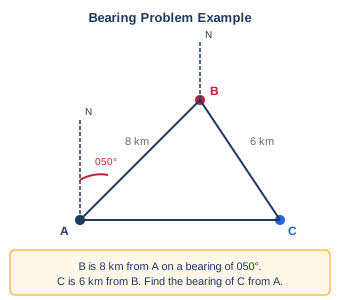
From point A, B is on a bearing of 060° at a distance of 10 km. From B, C is on a bearing of 150° at a distance of 8 km. Find the direct distance from A to C.
Show Solution
Step 1: Draw the diagram with North lines at A and B.
Step 2: Find angle ABC. At B, the bearing of A (back bearing) = 060° + 180° = 240° The bearing of C from B = 150° Angle ABC = 240° - 150° = 90°
Step 3: Since angle ABC = 90°, use Pythagoras. $$AC^2 = AB^2 + BC^2$$ $$AC^2 = 10^2 + 8^2$$ $$AC^2 = 100 + 64 = 164$$ $$AC = \sqrt{164} = 12.8 \text{ km}$$
Answer: 12.8 km (3 s.f.)
Examiner's View
Mark allocation: Reading/stating bearings: 1-2 marks. Problems with trig: 3-5 marks.
Common errors examiners see:
- Measuring anticlockwise from North
- Not using three figures (writing 45° instead of 045°)
- Confusing "bearing of B from A" with "bearing of A from B"
- Forgetting to draw North lines
What gains marks:
- Drawing clear diagrams with North arrows
- Writing bearings as three figures
- Showing angle calculations clearly
AQA Notes
AQA often combines bearings with the cosine or sine rule.