

Arcs and Sectors
The Skill
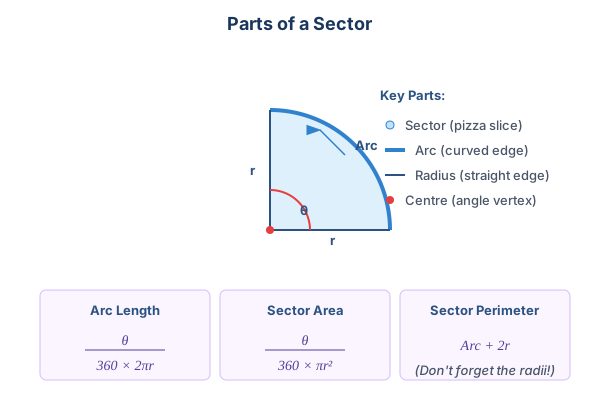
A sector is a "pizza slice" of a circle. An arc is a portion of the circumference.
Key Vocabulary
- Sector: The region bounded by two radii and an arc
- Arc: The curved edge of the sector
- Angle: The angle at the centre of the circle (usually $\theta$)
- Minor sector/arc: Smaller than a semicircle ($\theta < 180°$)
- Major sector/arc: Larger than a semicircle ($\theta > 180°$)
The Fraction of a Circle
The key to arc and sector calculations is finding what fraction of the circle you have:
$$\text{Fraction} = \frac{\theta}{360}$$
Arc Length
An arc is a fraction of the circumference:
$$\text{Arc length} = \frac{\theta}{360} \times 2\pi r = \frac{\theta}{360} \times \pi d$$
Example: Find the arc length of a sector with radius 8 cm and angle 45°.
$$\text{Arc length} = \frac{45}{360} \times 2\pi \times 8 = \frac{1}{8} \times 16\pi = 2\pi = 6.28\text{ cm (3 s.f.)}$$
Area of a Sector
A sector is a fraction of the full circle area:
$$\text{Sector area} = \frac{\theta}{360} \times \pi r^2$$
Example: Find the area of a sector with radius 10 cm and angle 72°.
$$\text{Area} = \frac{72}{360} \times \pi \times 10^2 = \frac{1}{5} \times 100\pi = 20\pi = 62.8\text{ cm}^2 \text{ (3 s.f.)}$$
Perimeter of a Sector
The perimeter includes the arc AND the two straight edges (radii):
$$\text{Perimeter} = \text{Arc length} + 2r$$
Working Backwards
You may need to find the angle or radius from given information.
Example: A sector has area $15\pi$ cm² and radius 6 cm. Find the angle.
$$15\pi = \frac{\theta}{360} \times \pi \times 36$$ $$15\pi = \frac{36\pi\theta}{360}$$ $$15 = \frac{36\theta}{360} = \frac{\theta}{10}$$ $$\theta = 150°$$
Radians (Higher Only)
At higher level, angles may be given in radians:
- $\pi$ radians = 180°
- 1 radian ≈ 57.3°
With radians:
- Arc length = $r\theta$
- Sector area = $\frac{1}{2}r^2\theta$
Sector Anatomy
The Traps
Common misconceptions and how to avoid them.
Forgetting to include radii in sector perimeter "The Missing Radii"
The Mistake in Action
Find the perimeter of a sector with radius 6 cm and angle 60°.
Wrong: Perimeter = Arc length = $\frac{60}{360} \times 2\pi \times 6 = 2\pi = 6.28$ cm
Why It Happens
Students confuse arc length with sector perimeter, forgetting that a sector has two straight edges.
The Fix
The perimeter of a sector includes:
- The arc (curved edge)
- Two radii (straight edges)
$$\text{Perimeter} = \text{Arc length} + 2r$$
Arc length = $\frac{60}{360} \times 2\pi \times 6 = 2\pi$ cm
Perimeter = $2\pi + 2(6) = 2\pi + 12 = 18.28$ cm (3 s.f.)
Spot the Mistake
Sector perimeter
= Arc length = $2\pi$
Click on the line that contains the error.
Getting the angle fraction upside down "The Fraction Flip"
The Mistake in Action
Find the area of a sector with radius 8 cm and angle 45°.
Wrong: Area = $\frac{360}{45} \times \pi \times 8^2 = 8 \times 64\pi = 512\pi$ cm²
Why It Happens
Students set up the fraction as $\frac{360}{\theta}$ instead of $\frac{\theta}{360}$.
The Fix
The sector is a fraction of the whole circle, where the fraction = $\frac{\theta}{360}$.
45° is less than 360°, so the fraction should be less than 1.
$$\text{Sector area} = \frac{45}{360} \times \pi \times 8^2 = \frac{1}{8} \times 64\pi = 8\pi = 25.1 \text{ cm}^2$$
Quick check: A sector should be smaller than the full circle, not 8 times bigger!
Spot the Mistake
Sector with angle 45°
$\frac{360}{45} \times \pi r^2$
Click on the line that contains the error.
Using diameter instead of radius in arc/sector formulas "The D for R Disaster"
The Mistake in Action
A sector has diameter 10 cm and angle 72°. Find the arc length.
Wrong: Arc = $\frac{72}{360} \times 2\pi \times 10 = \frac{1}{5} \times 20\pi = 4\pi$ cm
Why It Happens
Students use the diameter value directly without halving it to get the radius.
The Fix
The formula uses radius, not diameter!
Diameter = 10 cm, so Radius = 5 cm
Arc length = $\frac{72}{360} \times 2\pi \times 5 = \frac{1}{5} \times 10\pi = 2\pi = 6.28$ cm
Always check: Does the question give diameter or radius?
Spot the Mistake
Diameter 10 cm
Arc = $\frac{72}{360} \times 2\pi \times 10$
Click on the line that contains the error.
Using degree formula with radians or vice versa "The Radian Wrangle"
The Mistake in Action
Find the arc length where radius = 4 cm and angle = $\frac{\pi}{3}$ radians.
Wrong: Arc = $\frac{\pi/3}{360} \times 2\pi \times 4 = \frac{\pi}{540} \times 8\pi = \frac{8\pi^2}{540}$ cm
Why It Happens
Students use the degree formula ($\frac{\theta}{360} \times 2\pi r$) when the angle is given in radians.
The Fix
When using radians, the formulas simplify:
Arc length = $r\theta$ Sector area = $\frac{1}{2}r^2\theta$
For $r = 4$ and $\theta = \frac{\pi}{3}$:
Arc length = $4 \times \frac{\pi}{3} = \frac{4\pi}{3} = 4.19$ cm
Key: If the angle contains $\pi$ or is described as "radians", use the radian formulas!
Spot the Mistake
Angle = $\frac{\pi}{3}$ radians
Arc = $\frac{\pi/3}{360} \times 2\pi \times 4$
Click on the line that contains the error.
The Deep Dive
Apply your knowledge with these exam-style problems.
Level 1: Fully Worked
Complete solutions with commentary on each step.
Question
Find the arc length of a sector with radius 9 cm and angle 80°. Give your answer to 3 significant figures.
Solution
Formula: Arc length = $\frac{\theta}{360} \times 2\pi r$
$$\text{Arc length} = \frac{80}{360} \times 2\pi \times 9$$
$$= \frac{80}{360} \times 18\pi$$
$$= \frac{2}{9} \times 18\pi$$
$$= 4\pi$$
$$= 12.566...$$
Answer: 12.6 cm (3 s.f.)
Exact answer: $4\pi$ cm
Question
Find the area of a sector with radius 12 cm and angle 150°. Give your answer in terms of π.
Solution
Formula: Sector area = $\frac{\theta}{360} \times \pi r^2$
$$\text{Area} = \frac{150}{360} \times \pi \times 12^2$$
$$= \frac{150}{360} \times 144\pi$$
$$= \frac{5}{12} \times 144\pi$$
$$= \frac{5 \times 144\pi}{12}$$
$$= \frac{720\pi}{12}$$
$$= 60\pi \text{ cm}^2$$
Answer: $60\pi$ cm² (≈ 188.5 cm²)
Question
A sector has radius 7 cm and angle 120°. Find its perimeter. Give your answer to 2 decimal places.
Solution
Perimeter = Arc length + 2 × radius
Step 1: Find the arc length. $$\text{Arc} = \frac{120}{360} \times 2\pi \times 7 = \frac{1}{3} \times 14\pi = \frac{14\pi}{3}$$
Step 2: Add the two radii. $$\text{Perimeter} = \frac{14\pi}{3} + 2(7) = \frac{14\pi}{3} + 14$$
$$= 14.66... + 14 = 28.66...$$
Answer: 28.66 cm
Level 2: Scaffolded
Fill in the key steps.
Question
A sector has radius 5 cm and arc length 8 cm. Find the angle of the sector.
Level 3: Solo
Try it yourself!
Question
A sector has area 75π cm² and angle 120°. Find the radius.
Show Solution
Set up the equation: $$75\pi = \frac{120}{360} \times \pi r^2$$
Simplify the fraction: $$75\pi = \frac{1}{3} \times \pi r^2$$
Divide both sides by π: $$75 = \frac{r^2}{3}$$
Multiply both sides by 3: $$225 = r^2$$
Take the square root: $$r = \sqrt{225} = 15$$
Answer: The radius is 15 cm
Check: $\frac{120}{360} \times \pi \times 15^2 = \frac{1}{3} \times 225\pi = 75\pi$ ✓
Question
A pizza has diameter 30 cm. A slice is cut with an angle of 45°. Find: (a) the area of the slice (b) the length of crust (arc length)
Show Solution
Given: Diameter = 30 cm, so radius = 15 cm
(a) Area of slice (sector): $$\text{Area} = \frac{45}{360} \times \pi \times 15^2$$ $$= \frac{1}{8} \times 225\pi$$ $$= \frac{225\pi}{8}$$ $$= 28.125\pi \approx 88.4 \text{ cm}^2$$
(b) Length of crust (arc length): $$\text{Arc} = \frac{45}{360} \times 2\pi \times 15$$ $$= \frac{1}{8} \times 30\pi$$ $$= \frac{30\pi}{8} = 3.75\pi \approx 11.8 \text{ cm}$$
Answers: (a) 88.4 cm² (or $\frac{225\pi}{8}$ cm²) (b) 11.8 cm (or $3.75\pi$ cm)
Examiner's View
Mark allocation: Finding arc length or area is 2-3 marks. Combined problems (perimeter, working backwards) are 3-4 marks.
Common errors examiners see:
- Forgetting to include the radii in perimeter
- Using diameter instead of radius
- Using degrees formula with radians (or vice versa)
- Calculation errors with fractions
What gains marks:
- State the formula you're using
- Show the fraction $\frac{\theta}{360}$ clearly
- Give exact answers in terms of $\pi$ when asked
- Include units in your answer
AQA Notes
AQA often asks for exact answers in terms of $\pi$. Leave your answer as a multiple of $\pi$.