

Explain & Describe Questions
Getting Full Marks on Written Responses
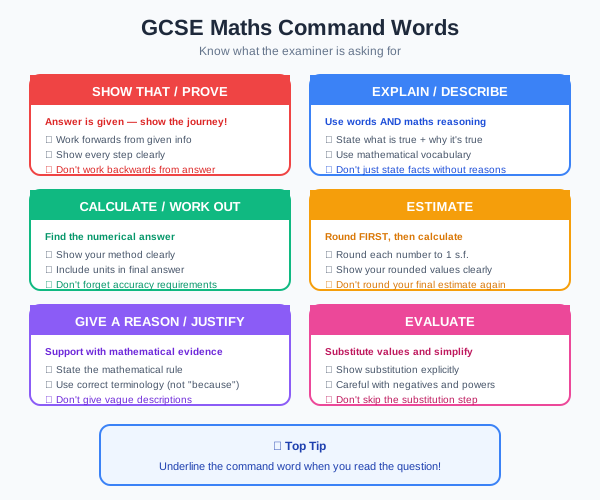
"Explain" and "Describe" questions test whether you truly understand the mathematics, not just whether you can calculate. These questions often catch students off guard because they require words, not just numbers.
Understanding the Difference
| Command | What It Means | Example Response Style |
|---|---|---|
| Explain | Give mathematical reasons for something | "Because... therefore... which means..." |
| Describe | Say what is happening or what you observe | "The graph shows... As x increases..." |
The Two-Part Rule for "Explain"
Most "explain" questions need two components to get full marks:
- A mathematical statement (what is true)
- A reason (why it is true)
Common "Explain" Question Types
Type 1: Explain an Error
"Sam says $\frac{2}{3} + \frac{1}{4} = \frac{3}{7}$. Explain why Sam is wrong."
❌ Weak answer: "Sam added the numerators and denominators."
✅ Strong answer: "Sam has added the numerators and denominators separately, but to add fractions you need a common denominator first. The correct answer is $\frac{8}{12} + \frac{3}{12} = \frac{11}{12}$."
Type 2: Explain Why a Statement is True
"The mean of five numbers is 8. Explain why the five numbers must add up to 40."
✅ Strong answer: "Mean = total ÷ number of values, so total = mean × number of values = 8 × 5 = 40."
Type 3: Explain the Effect
"The radius of a circle is doubled. Explain the effect on the area."
✅ Strong answer: "Area = $\pi r^2$, so if $r$ becomes $2r$, the new area is $\pi(2r)^2 = 4\pi r^2$. The area is multiplied by 4 (or quadrupled)."
"Describe" Questions in Statistics
These are particularly common in the Statistics strand, especially for graphs and data.
What to Include When Describing Correlation:
- Direction: positive or negative
- Strength: strong, moderate, or weak
- Context: refer to the actual variables, not just "x and y"
Example: "There is a strong positive correlation between hours of revision and test scores. This suggests that students who revise more tend to achieve higher marks."
What to Include When Describing a Distribution:
- Shape: symmetric, skewed left/right, bimodal
- Centre: where most data lies
- Spread: range, any outliers
- Context: what this means for the situation
Language That Earns Marks
Use mathematical vocabulary:
- "proportional to" not "related to"
- "inversely proportional" not "opposite"
- "correlation" not "pattern"
- "increases/decreases" not "goes up/down"
Be specific:
- "multiplied by 4" not "gets bigger"
- "gradient is negative" not "line goes down"
- "10% increase" not "a bit more"
How Marks Are Awarded
For a typical 2-mark "explain" question:
- 1 mark: Correct mathematical statement OR reason
- 2 marks: Both statement AND valid mathematical reasoning
For a 3-mark "explain" question, you typically need:
- Statement + Reason + Worked example or calculation