

Spaced Repetition
Stop cramming. Start spacing. Learn how to schedule your revision so topics actually stick.
You've probably experienced this: you revise a topic, feel confident, then three weeks later it's like you never learned it at all.
That's not a memory problem — it's a timing problem. And spaced repetition is the solution.
What Is Spaced Repetition?
Spaced repetition means reviewing material at gradually increasing intervals, rather than cramming everything in one go.
Instead of:
- Monday: Revise Pythagoras for 2 hours
- Never touch it again until the exam
You do:
- Monday: Learn Pythagoras (20 mins)
- Wednesday: Quick review (10 mins)
- Saturday: Practice problems (15 mins)
- Next week: Mixed practice including Pythagoras (10 mins)
- Two weeks later: Include in a practice test
Same total time. Massively better results.
Why Spacing Works
Remember the forgetting curve? Your brain forgets information rapidly unless you reinforce it.
Here's the key insight: each time you successfully recall something, you slow down the forgetting process.
The first time you review, you might forget it within a day. Review again, and you might remember for three days. Review again, and it lasts a week. Then two weeks. Then a month.
Eventually, the information becomes so deeply encoded that you barely need to think about it — like how you don't need to "remember" that $2 + 2 = 4$.
Spacing works because:
- It forces retrieval — You have to actually recall the information, not just recognise it
- It creates desirable difficulty — Slightly forgetting something makes relearning it more powerful
- It builds long-term memory — Short gaps build short-term memory; longer gaps build long-term memory
The 2-3-5-7 System
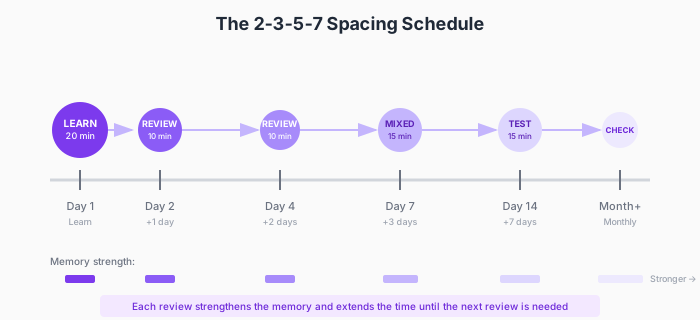
The simplest spacing system to use is the 2-3-5-7 rule:
After first learning something, review it:
- Day 2 (1 day later)
- Day 4 (2 days after that)
- Day 7 (3 days after that)
- Day 14 (7 days after that)
Then monthly after that until your exams.
Example: Learning the Quadratic Formula
Day 1 (Monday): Learn the quadratic formula and how to use it $$x = \frac{-b \pm \sqrt{b^2 - 4ac}}{2a}$$ Do 5-6 practice problems with your notes open.
Day 2 (Tuesday): Without looking at notes, try to write down the formula. Do 3 problems from memory. Check your answers.
Day 4 (Thursday): Quick test — write down the formula, solve one problem. If you struggled, do a couple more.
Day 7 (Sunday): Include a quadratic equation in a mixed practice session alongside other topics.
Day 14: Include in a longer practice test. By now it should feel more automatic.
The Leitner Box System
If you're using flashcards (and you should be for formulas and key facts), the Leitner system is a brilliant way to build in spacing automatically.
You need 5 boxes (or 5 sections in a box, or 5 piles on your desk):
| Box | Review Frequency | What Goes Here |
|---|---|---|
| Box 1 | Every day | New cards, cards you got wrong |
| Box 2 | Every 2 days | Cards you got right from Box 1 |
| Box 3 | Every 4 days | Cards you got right from Box 2 |
| Box 4 | Every week | Cards you got right from Box 3 |
| Box 5 | Every 2 weeks | Cards you got right from Box 4 |
The rules are simple:
- Get a card right → It moves forward one box
- Get a card wrong → It goes back to Box 1
This means you spend more time on the things you find difficult, and less time on things you already know. The system automatically adapts to you.
Maths Flashcard Ideas
What should go on your maths flashcards?
Front: The formula name or a "when to use" prompt Back: The formula and a quick example
Examples:
| Front | Back |
|---|---|
| Pythagoras' Theorem | $a^2 + b^2 = c^2$ (where $c$ is the hypotenuse) |
| Area of a trapezium | $A = \frac{1}{2}(a + b)h$ |
| When do I use SOHCAHTOA? | Right-angled triangles with an angle involved. Sin = O/H, Cos = A/H, Tan = O/A |
| Gradient from two points | $m = \frac{y_2 - y_1}{x_2 - x_1}$ |
| What does "inversely proportional" mean? | $y \propto \frac{1}{x}$ so $y = \frac{k}{x}$ as one goes up, the other goes down |
Pro tip: Don't just memorise the formula — include when to use it. In the exam, the hard part is often recognising which formula you need.
Building a Spacing Schedule
Here's how to create your own spacing schedule:
Step 1: List Your Topics
Write out all the topics you need to revise. For GCSE Maths, this might be 30-50 topics across Number, Algebra, Geometry, and Statistics.
Step 2: Prioritise
Not all topics are equal. Rate each one:
- 🔴 Red: Don't understand it / always get it wrong
- 🟡 Amber: Okay but not confident
- 🟢 Green: Pretty solid
Red topics need more frequent review. Green topics can have longer gaps.
Step 3: Create a Rotation
Don't try to revise everything every day. Instead, rotate through topics:
Week 1:
- Monday: Algebra (equations, inequalities)
- Tuesday: Number (fractions, percentages)
- Wednesday: Geometry (angles, Pythagoras)
- Thursday: Statistics (averages, probability)
- Friday: Mixed practice from the week
Week 2:
- Return to Week 1 topics briefly
- Add new topics to the rotation
- Longer mixed practice session
Step 4: Track What You've Covered
Use a simple tracker (spreadsheet, notebook, or app) to record:
- What you revised
- When you revised it
- How well it went (1-5 rating)
- When to review it next
This stops topics falling through the cracks.
Common Spacing Mistakes
❌ Spacing Too Closely
If you review something every single day, you're not giving your brain time to forget slightly — which means you're not building long-term memory as effectively.
❌ Spacing Too Widely
Leave it too long and you'll have forgotten too much. You want to review just before you would have forgotten — that's the sweet spot.
❌ Only Reviewing Easy Topics
It's tempting to keep reviewing the topics you already know (because it feels good). But your time is better spent on weaker areas.
❌ Not Actually Testing Yourself
Spacing only works if you're actually retrieving information during reviews. Just reading through notes doesn't count. You need to test yourself — close the book and try to recall what you know.
Making It Realistic
Let's be honest: you're not going to perfectly follow a spacing schedule every single day. Life happens. That's fine.
The key principles to remember:
- Some spacing is better than no spacing — Even rough spacing beats cramming
- Little and often beats big and rare — 20 minutes four times beats 90 minutes once
- Review before you've completely forgotten — A slight struggle to remember is good; complete blankness means you waited too long
- Use mixed practice — Don't just review one topic at a time
If you can revise for 20-30 minutes on most days, rotating through topics and genuinely testing yourself, you'll be in excellent shape for your exams.
Quick Start: This Week
Here's how to start spaced repetition right now:
- Pick 3 topics you're not confident with
- Today: Spend 15 minutes on Topic 1 — learn it, do a few problems
- Tomorrow: Quick 5-minute test on Topic 1. Then 15 minutes on Topic 2.
- Day 3: Quick test on Topics 1 and 2. Then 15 minutes on Topic 3.
- Day 5: Mixed practice on all three topics
- Next week: Add new topics while continuing to review these
Build the habit first. Perfect the system later.
Next: Spacing tells you when to revise. But how should you revise during those sessions?
- 🧪 Retrieval Practice — The most powerful revision technique
- 🔀 Interleaving — Why mixing topics beats blocking them